METHUSELAH ARCHIVE PRACTITIONERS / JAMES MANBY GULLY
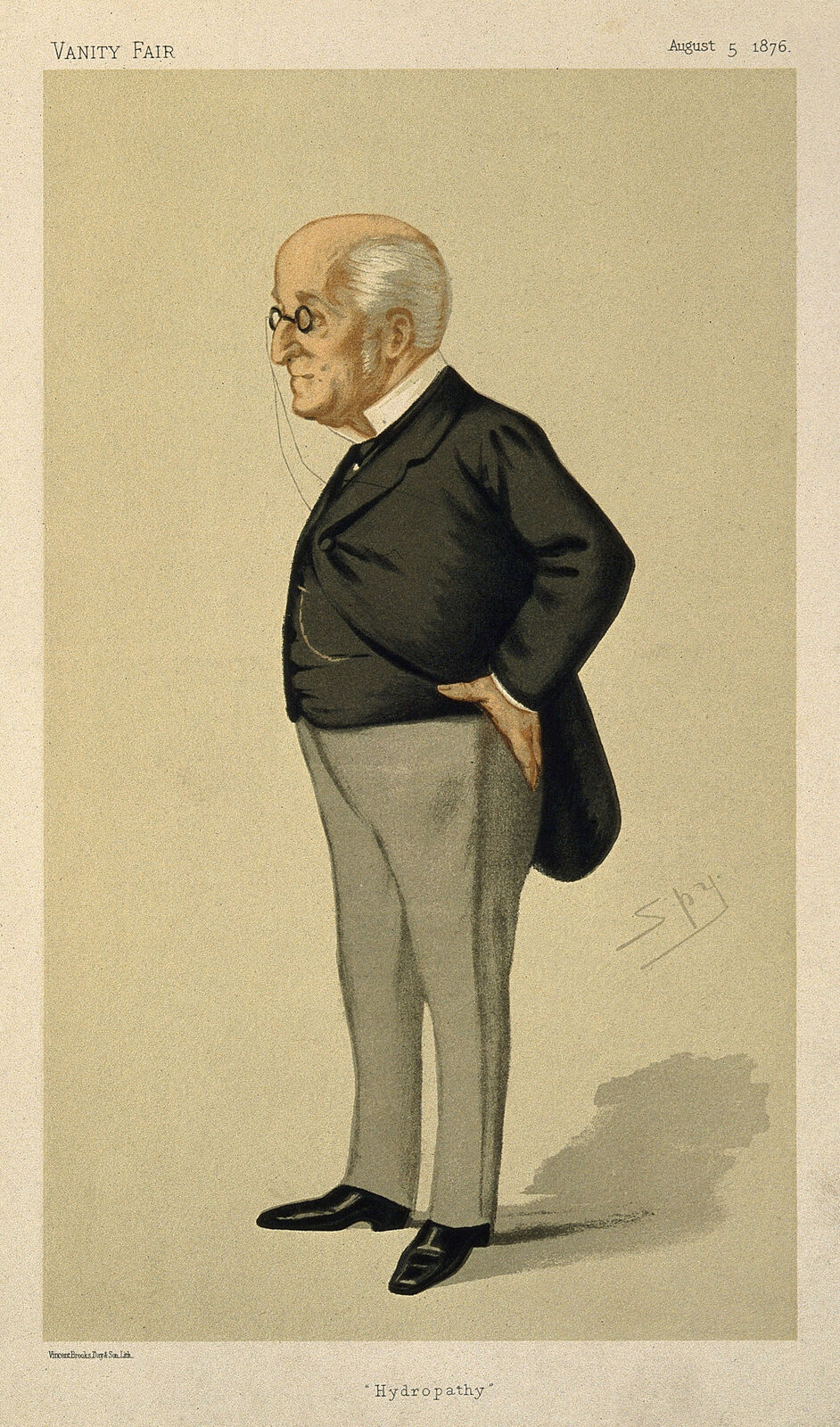
Full-length colour caricature, shown in profile, of a balding, clean-shaven elderly man with white hair and round spectacles, wearing a black coat and grey trousers, with his hands clasped behind his back, captioned 'Hydropathy,' in the satirical exaggerated style of Vanity Fair caricatures.
PUBLIC DOMAIN source

James Manby Gully

individual · Malvern, Worcestershire, England (Tudor House and Holyrood House establishments)
lived:1808–1883
active:1842–1872
type:individual
role:promoter
location:Malvern, Worcestershire, England (Tudor House and Holyrood House establishments)
eventual status:publicly_disconfirmed
FINANCIAL CONFLICTS
Gully personally directed the fee-charging Tudor House and (later) Holyrood House establishments at Malvern; no source in this bundle establishes who owned the properties. He was not the only party paid: attendants, lodging, and board were billed alongside his own fee (Marland & Adams, 2009). Of the 1840s Malvern rates recorded by Marland and Adams -- 4-5 guineas a week for the establishment, 2 shillings 6 pence to bath attendants, and a 2-guinea initial consultation -- it is the consultation fee those authors tie to Gully himself, and Marland and Adams conclude that his Malvern practice did not center on treating the poor or democratizing the water cure, but instead chiefly administered expensive regimes of treatment to wealthy patients. This sits against Gully's own published rhetoric attacking orthodox medicine's profit motive: in his 1846 book he wrote that no financial interest in the sale of drugs could suppress the truth that the body itself supplies its own agent of restoration, with medical art only assisting that agency (paraphrased from the passage quoted in Price, 1981, p. 276). The conflict named here is the gap between that stated position and a practice sustained by premium fees -- of which the sources tie the 2-guinea consultation to him personally -- levied on a wealthy clientele that included Tennyson, Darwin, and Carlyle.
INTERVENTIONS PROMOTED
NOTABLE PATIENTS
EXTERNAL REFERENCES
NOTES

James Manby Gully (14 March 1808 to 27 March 1883) was born at Kingston, Jamaica, the son of a coffee planter, and came to England as a child (Dictionary of National Biography). He studied medicine at Edinburgh and at the École de Médecine in Paris, where he trained as an “externe” pupil and dresser under Dupuytren at the Hôtel Dieu, took his M.D. at Edinburgh in 1829, and established himself as a London physician in 1830 (DNB). Around 1837 he met James Wilson, and the two agreed that the medical profession’s routine of drugging and bleeding was ineffective and potentially harmful (DNB). In 1842, after Wilson returned from Silesia convinced of the power of Priessnitz’s cold-water cure, the two men selected Malvern, Worcestershire, as their base: Wilson opened Gräfenberg House in June 1842, and Gully followed in October the same year at Tudor House, with a later addition, Holyrood House, for women patients (Price, 1981, p. 273).

Gully proved the more commercially successful of the two practitioners, and the DNB records that Malvern owed much of its prosperity to him. His patients over the following three decades included the poet Alfred Tennyson (1847), the naturalist Charles Darwin (1849), and the essayist Thomas Carlyle (1851), among others (Price, 1981, p. 276). He resigned his practice in 1872 to his partner William T. Fernie (DNB). Four years later, in 1876, his name surfaced repeatedly at the inquest into the death by poisoning of the barrister Charles Bravo; disclosures of Gully’s earlier intimate relationship with Bravo’s widow, Florence, severely damaged his reputation, and at the inquest’s conclusion his name was struck from every medical society and journal of the day (DNB). He died in 1883, his standing in the profession never restored.