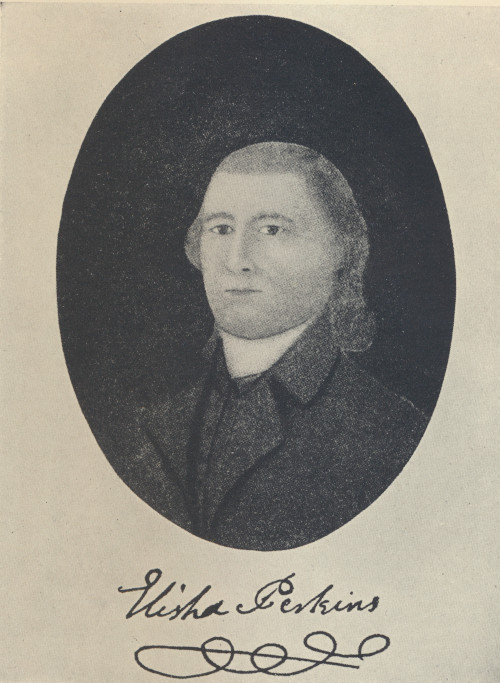
Elisha Perkins
"drawing out the noxious electrical fluid that lay at the root of suffering"
Elisha Perkins was an American physician, son of a Connecticut physician, who studied medicine privately under his father at Plainfield and joined the Connecticut Medical Society as a founding signatory at its 1792 charter. In 1796 he was granted a United States patent for “Metallic Tractors,” a pair of pointed metal pieces of a claimed special alloy that were to be drawn lightly across the surface of the body to relieve rheumatism, gout, paralysis, inflammation, and a range of other conditions, on the proposed mechanism of drawing out a noxious electrical fluid. Within a year the tractors were in widespread elite use in the United States and (through Benjamin Douglas Perkins’s London publication of the Influence of Metallic Tractors on the Human Body, 1798) in fashionable Bath and London society. The Connecticut Medical Society expelled Perkins in 1797 on the basis of his promotion of the tractors as “delusive quackery.” Perkins died in New York City in September 1799 of yellow fever, contracted while administering a separate “antiseptic” treatment regimen of his own invention (vinegar and salt) to yellow-fever patients in the New York epidemic of that year. The encoding of eventual_status as died_from_own_intervention refers to the antiseptic-regimen episode rather than to the Tractors, which Perkins himself outlived only by three years and which were the subject of John Haygarth’s fictitious-tractor disconfirmation in early 1799 (published 1800). George Washington is widely reported in American popular sources to have purchased a set of tractors but this attribution is not securely documented in primary sources contemporaneous with Washington and is not directly cited by either Haygarth 1800 or Wootton 2006.