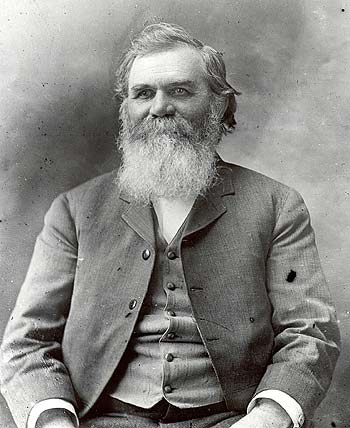
Daniel David (D.D.) Palmer
Daniel David Palmer was born 7 March 1845 in Pickering Township, Canada West (now Ajax, Ontario), and died 20 October 1913 in Los Angeles, officially of typhoid fever (Wikipedia; EBSCO Research Starters 2023). Before chiropractic he worked as a beekeeper, schoolteacher, and grocer, then took up magnetic healing in the mid-1880s in Burlington and later Davenport, Iowa; a contemporary 1894 Davenport newspaper called him “a crank on magnetism” and “a quack” (Wikipedia, “D. D. Palmer”).
On 18 September 1895, Palmer said he restored the hearing of Harvey Lillard, the janitor of the Davenport building where he kept his office, by adjusting a vertebra in Lillard’s back (Batinić et al. 2013); Lillard’s own daughter later gave a different account of what happened (Wikipedia, “D. D. Palmer”). From that episode Palmer built a general theory: an “Innate Intelligence,” which he described as a segment of that Intelligence which fills the universe, flows through the nervous system and maintains health, and a “subluxated” vertebra obstructs that flow and produces disease (Brown 2010). He founded the Palmer School of Chiropractic in Davenport in 1897, teaching the new system for a fee (Wikipedia, “D. D. Palmer”; EBSCO Research Starters 2023).
In 1906 Palmer was convicted in Iowa of practicing medicine without a license. Rather than pay the fine, he chose jail, telling a reporter that he was not in a cell for lack of principal, but for an abundance of principle (Brown 2010). He sold his interest in the Davenport school to his son, B.J. Palmer, shortly afterward, and went on to found further chiropractic schools in California, Oregon, and Oklahoma before his death in 1913 (EBSCO Research Starters 2023).
eventual_status is recorded as publicly_disconfirmed, attaching to the founding claim — that vertebral subluxation is the general cause of disease and its correction the general cure — rather than to chiropractic’s later, narrower, and separately evidenced role in musculoskeletal pain management. A 2009 peer-reviewed epidemiological review found the subluxation construct fails Hill’s criteria of causation and “has no valid clinical applicability” to any disease process (Mirtz et al. 2009), and a 2021 systematic review of randomized trials found no evidence that spinal manipulation affects non-musculoskeletal disease (Côté et al. 2021).