METHUSELAH ARCHIVE PRACTITIONERS / BERNARR MACFADDEN
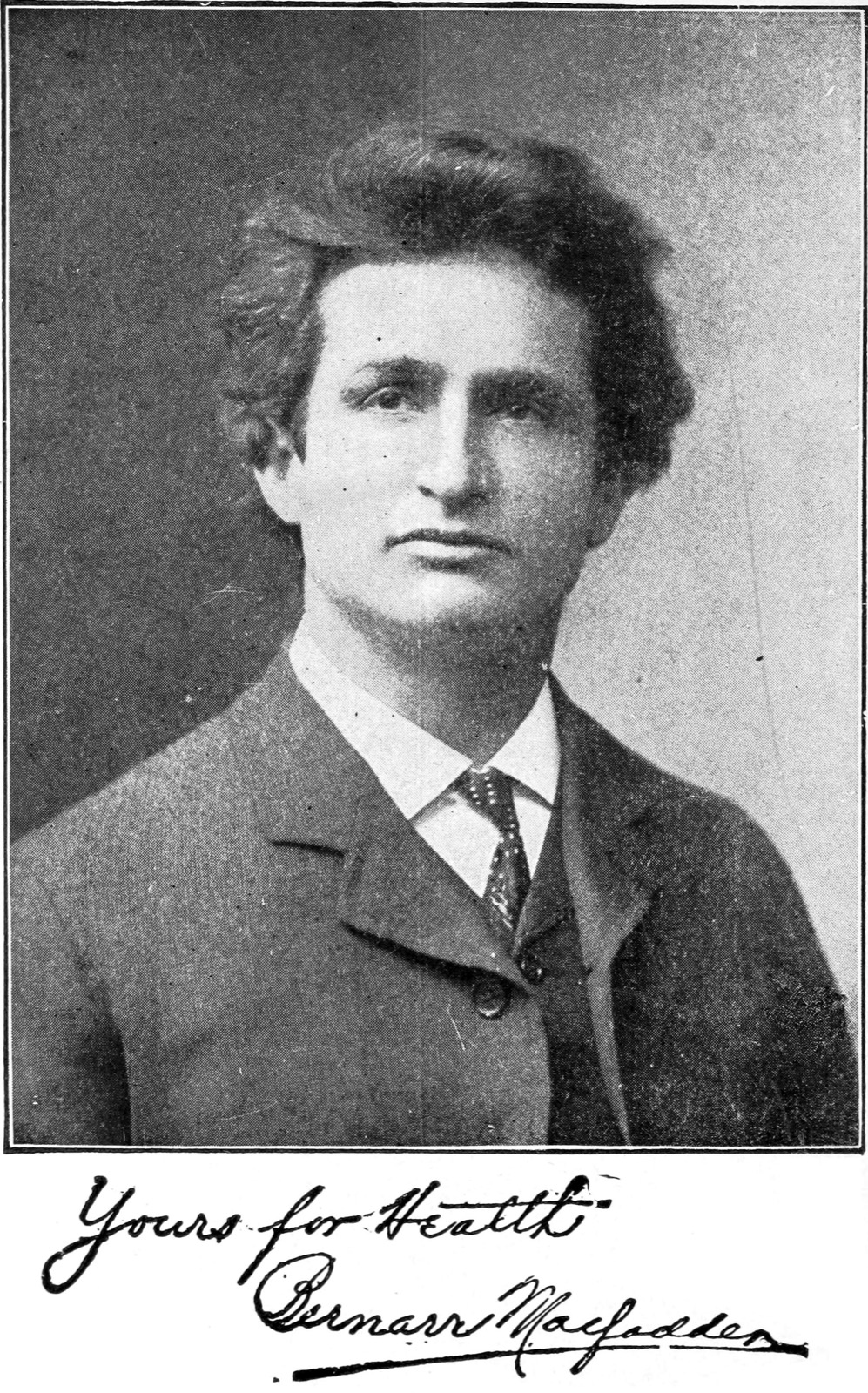
Sepia head-and-shoulders portrait of a young man in a suit and tie, with a handwritten inscription reading 'Yours for Health, Bernarr Macfadden' beneath it.
PUBLIC DOMAIN source

Bernarr Macfadden

individual · United States (Missouri, then New York and New Jersey) and London
lived:1868–1955
active:1899–1955
type:individual
role:promoter
location:United States (Missouri, then New York and New Jersey) and London
eventual status:died_from_own_intervention
"Weakness is a crime."
FINANCIAL CONFLICTS
Macfadden's income and public standing came from the Macfadden Publications magazine empire, which was the vehicle for his health-and-longevity doctrine. By 1935 his pulp publishing empire had a total of 35 million readers, and he died a multimillionaire in 1955 (Encyclopaedia Britannica). The conflict is named on the documented facts: the magazines that made his fortune (beginning with Physical Culture, 1899) sold the very fasting, diet, and drugless-living doctrine the case examines, and a history of early-twentieth-century diet reform records that for figures such as Macfadden commercial imperatives underpinned their activities (Stark 2018). The conflict is that the promoter's wealth and platform depended on the continued currency of a doctrine he advanced without controlled evidence for its central disease-cure and rejuvenation claims. He also sold his own books and operated health resorts; this entry does not claim he alone profited from those operations, which also paid staff and suppliers.
INTERVENTIONS PROMOTED
EXTERNAL REFERENCES
NOTES

Bernarr Macfadden (1868-1955) was an American physical culturist and magazine publisher who promoted fasting, diet, exercise, and “drugless” living as remedies for disease and routes to a long, vigorous life. Born near Mill Spring, Missouri, on 16 August 1868, he built a publishing empire on the doctrine: he founded the magazine Physical Development in 1898 and the more successful Physical Culture in 1899, and by 1935 his pulp publishing empire had a total of 35 million readers (Encyclopaedia Britannica). He is recorded here as a promoter rather than the vendor of a single substance: his system was a regimen, and his commercial interest lay in the magazines, books, and resorts that carried it.

His eventual_status is recorded as died_from_own_intervention. Macfadden died a multimillionaire on 12 October 1955 in Jersey City, New Jersey, after refusing medical treatment for a digestive disorder (Encyclopaedia Britannica), consistent with the drugless doctrine he had promoted for half a century. He was 87. The case treats his death as the practical disconfirmation of a doctrine that promised rejuvenation and an extended, disease-free life: the founder of the fasting cure declined ordinary medical care and died of an untreated illness short of the exceptional longevity his system advertised. The standard scholarly biography is Robert Ernst’s Weakness Is a Crime (Syracuse University Press, 1991), whose title takes up Macfadden’s own slogan.