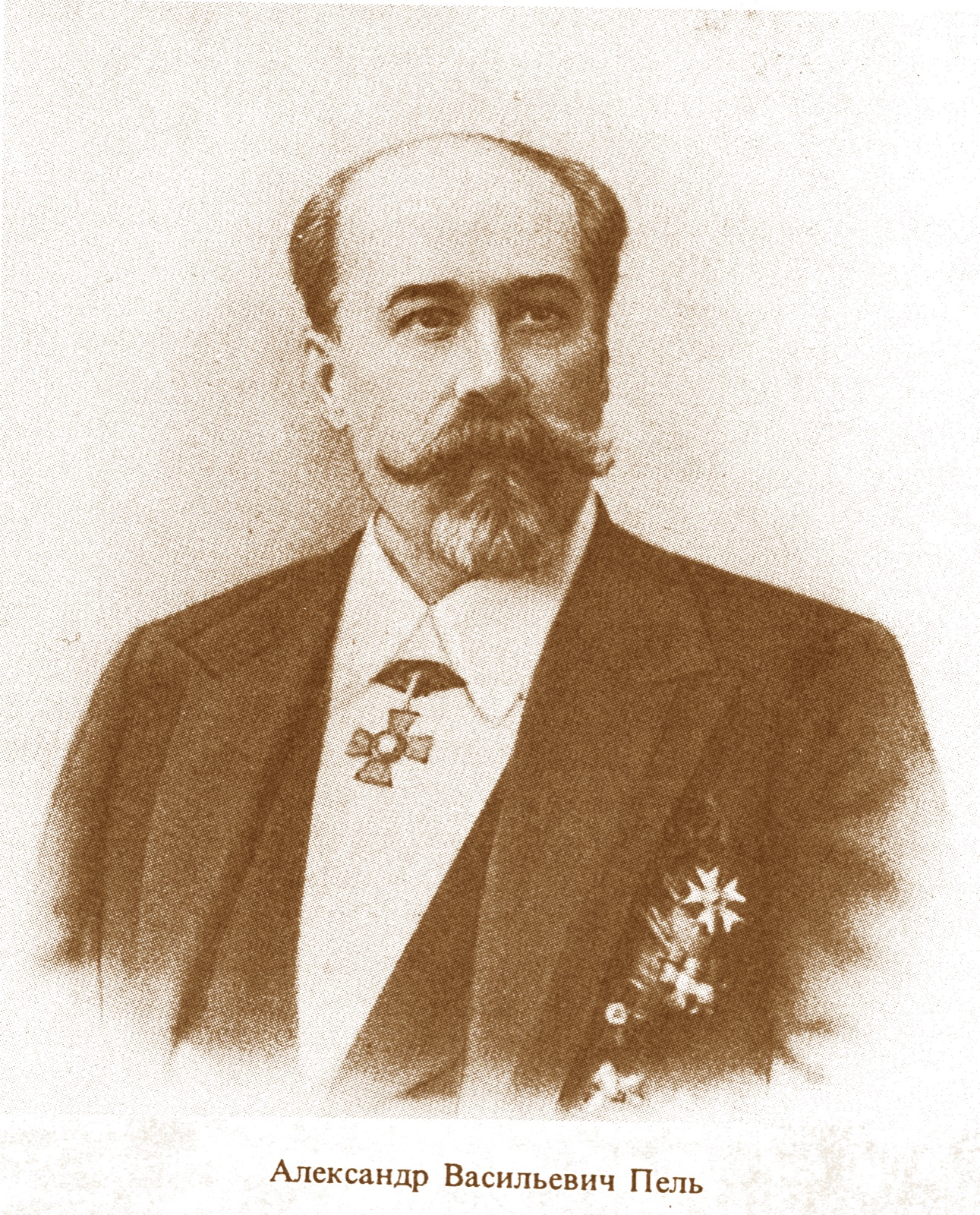
Alexander von Poehl
Alexander von Poehl (Russian Александр Васильевич Пель; born 27 February 1850 in St. Petersburg, died 28 August 1908 in Berlin) was a Baltic German pharmacist and chemist who ran the best-known pharmacy in St. Petersburg. His father had acquired it in 1848 and it became the imperial court pharmacy (Hofapotheke) in 1871; Poehl took it over in 1875 and built a research laboratory there. He held doctorates from Gießen (1876) and Dorpat (1882), received an honorary professorship at the Imperial Medical Academy in St. Petersburg in 1886, sat on the medical advisory council of the Ministry of the Interior from 1878 to 1892, and was raised to hereditary nobility in 1884. He published over 150 papers in analytical, medical, and forensic chemistry and is credited with sealing sterile injection solutions into glass ampoules. (Biographical detail from the German Wikipedia article; birth and death years independently confirmed by the Wellcome authority-controlled name, Poehl 1850-1908, and Wikidata Q1706566.)
From the early 1890s Poehl built an organotherapy around “spermin,” a crystalline base he isolated from semen and animal organs and standardized into the branded preparation Sperminum-Poehl. His court-pharmacist standing, academic titles, own laboratory, and own journal gave the products an institutional authority that lay nostrum-sellers lacked, and that authority, not controlled evidence, carried the spermine theory into the German-, Russian-, and English-language medical literature. The doctrine was severely criticized and finally rejected (Mann, The Biochemistry of Semen, 1954).