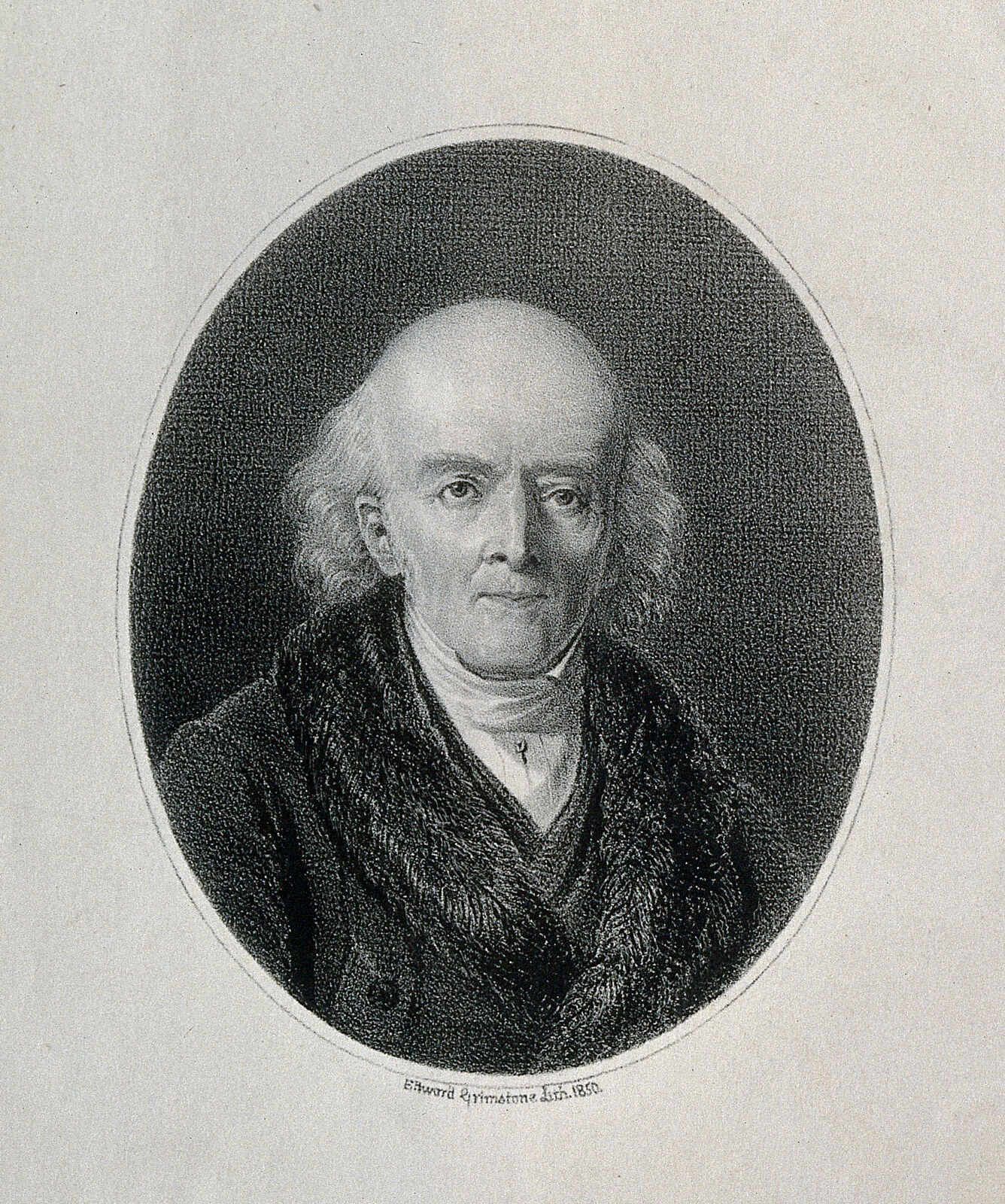
Samuel Hahnemann
Samuel Hahnemann (born Meissen, 1755; died Paris, 1843) was the founder of homeopathy. He took a medical degree at Erlangen in 1779 and worked for years as a physician and medical translator before, around the mid-1790s, reporting that doses of cinchona bark produced fever-like symptoms in him while healthy. From that observation he drew the principle of similars, first published in his 1796 essay in Hufeland’s Journal der practischen Arzneykunde und Wundarzneykunst, and systematized in the Organon der rationellen Heilkunde (Dresden, 1810). To the law of similars he added the law of infinitesimals: that serial dilution with succussion (potentization) develops a remedy’s power even past the point where no molecule of the original substance remains, all acting on the body’s vital force (Lebenskraft).
The publicly_disconfirmed status attaches to the central claims of the doctrine, not to Hahnemann’s stature as a reformer of the brutal drugging and bleeding of his era. The high-dilution claim was tested under blinded, controlled conditions in the Nuremberg salt test of 1835 and found to produce no effect distinguishable from water (Stolberg 2006), and a 2005 Lancet meta-analysis concluded that homeopathy’s clinical effects are compatible with placebo (Shang et al. 2005). In his final years Hahnemann married his second wife, Mélanie d’Hervilly, in 1835, moved to Paris, and built a lucrative practice there; he completed the sixth edition of the Organon in 1842, but it was not published until 1921 (Mix and Cameron 2011). Loudon’s history records that he died a millionaire in Paris in 1843.