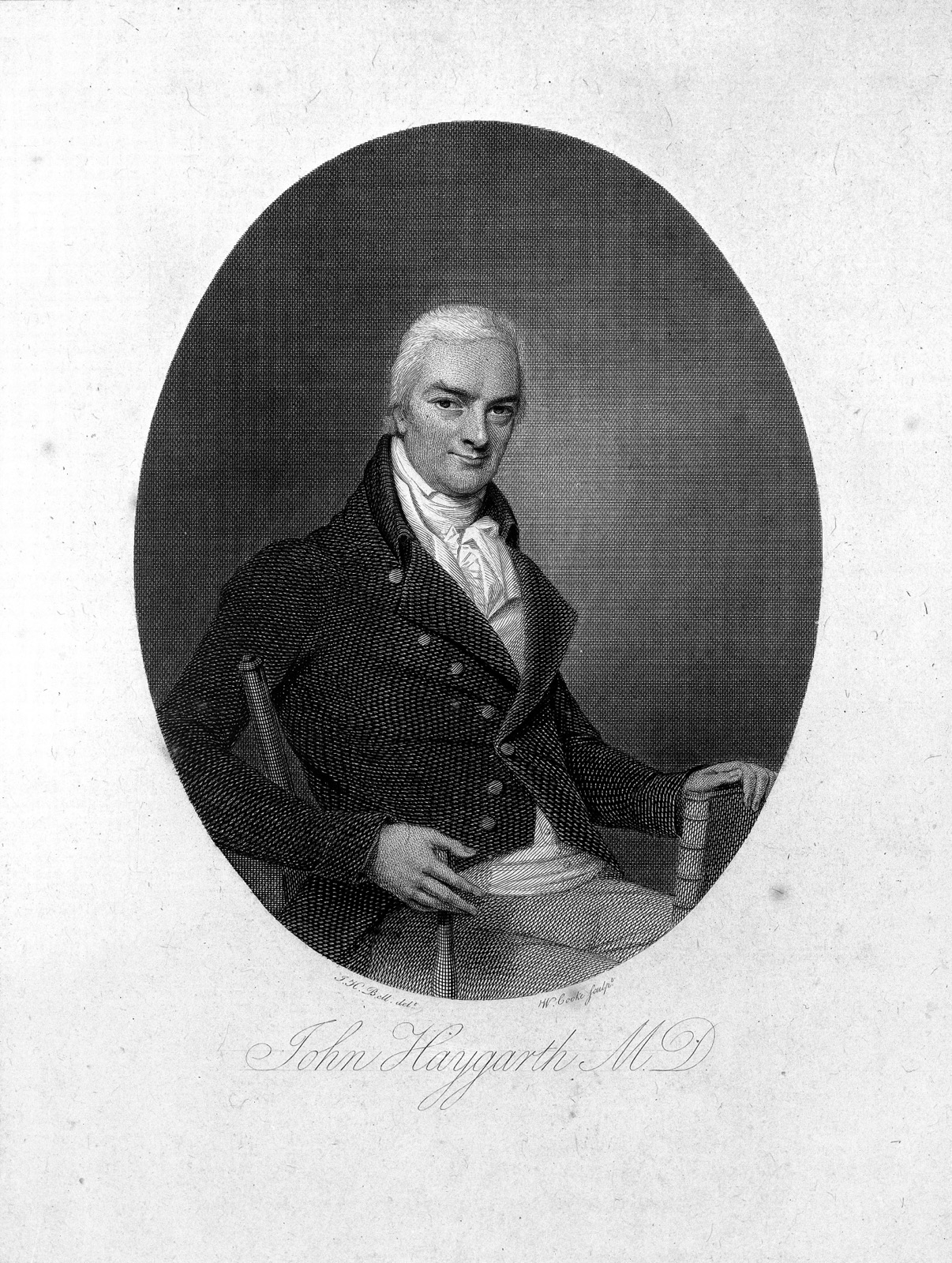
John Haygarth
"to a degree which has never been suspected, what powerful influence upon diseases is produced by mere imagination"
John Haygarth was an English physician trained at the University of Edinburgh (MD 1766), the son of a Westmorland yeoman family, and one of the most methodologically careful clinical investigators of the late 18th century. From 1767 to 1798 he was the senior physician at Chester Infirmary, where he developed the 1778 to 1783 “Chester Rules of Prevention” for the control of nosocomial infection (now recognized as the first systematic recognition of iatrogenic disease transmission in an English hospital) and was an early advocate of smallpox inoculation. He was elected Fellow of the Royal Society in 1781. After retirement to Bath in 1798, Haygarth conducted the fictitious-tractor experiment of January 1799 at the Bath General Hospital, testing wooden pseudo-tractors carved to resemble Perkins’s patented metallic pair on five chronic patients; the result was confirmed shortly afterward by an independent imitation-tractor test by Richard Smith of Bristol Royal Infirmary. Haygarth published the results in 1800 as Of the Imagination as a Cause and as a Cure of Disorders of the Body. The experiment is the canonical methodological case in the early history of placebo-controlled clinical trials and is the historical priority example for the proposition that an elite-targeted commercial medical intervention can be disconfirmed by a simple imitation test conducted at zero cost. Haygarth also reported in the same publication a small number of cases in which the fictitious tractors made patients worse (the first documented nocebo observation in the modern medical literature). His name is the founding ancestor of the archive’s analytical tradition: the methodology that the archive uses to evaluate Brown-Séquard, Voronoff, Niehans, and TPE-IVIG was invented by Haygarth in 1799 to evaluate Perkins. This practitioner record is the first entity of the disconfirmer role-type in the archive.