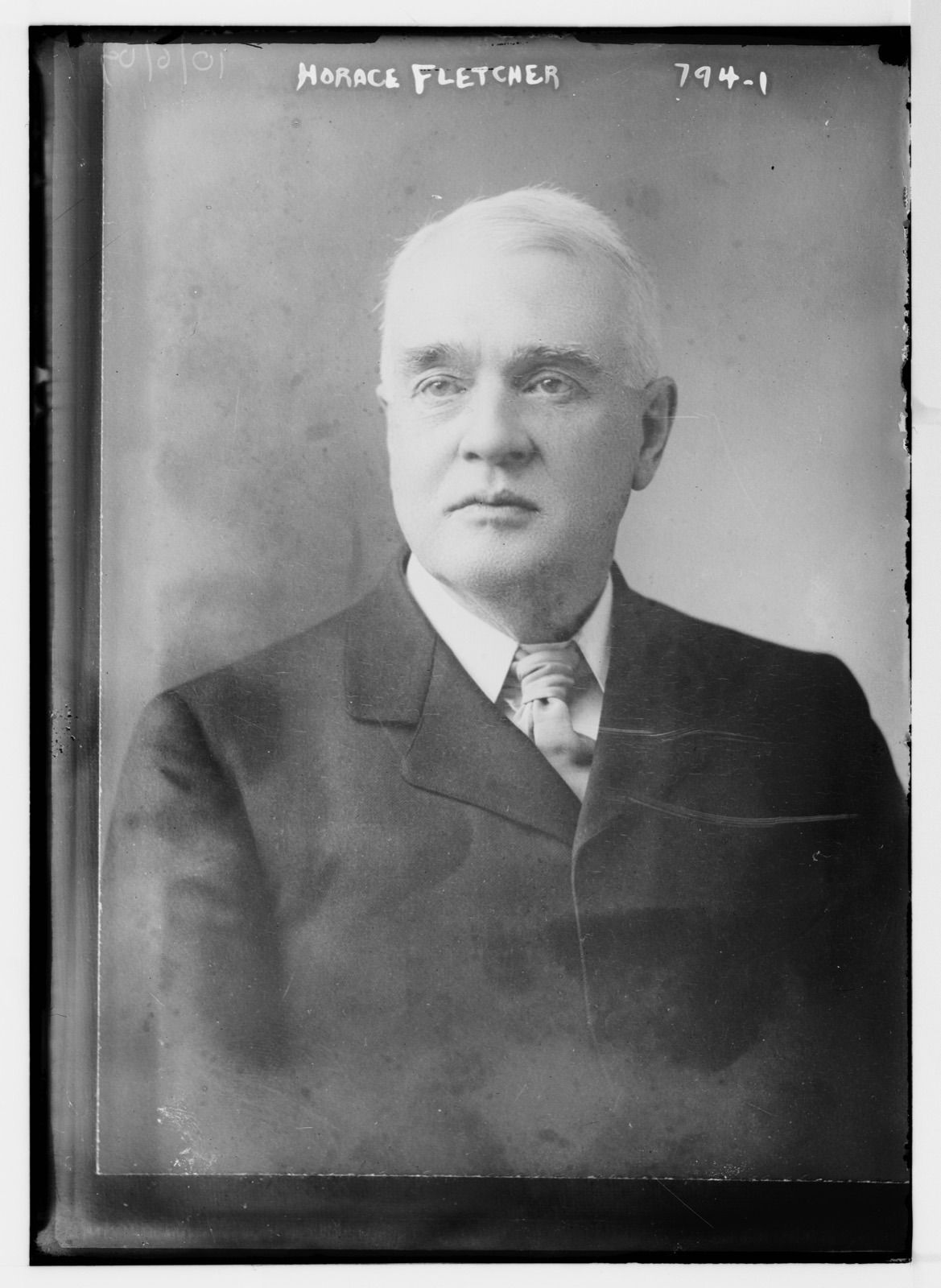
Horace Fletcher
"Nature will castigate those who don't masticate."
Horace Fletcher (1849-1919) was an American food-reform promoter known as “the Great Masticator.” He was born in Lawrence, Massachusetts, on 10 August 1849, left home at sixteen, and worked as an importer, an opera-house manager in New Orleans, a painter, and a writer before turning to nutrition. In his late forties, troubled by dyspepsia and excess weight and refused life insurance, he devised a system of thorough chewing that he credited with restoring his health, and he promoted it for roughly two decades, from about 1898 until his death.
Fletcher is the promoter side of the transaction. He had no clinic and sold no substance; the doctrine was disseminated through his commercially successful books (published by Frederick A. Stokes) and a paid lecture circuit, and its authority was reinforced by his self-presentation as a scientific test subject and by his prominent adherents. From 1902 he was studied at Yale by the physiological chemist Russell Chittenden, and at fifty-eight he performed gymnasium tests of strength and endurance that were reported as evidence of the regimen’s benefits. His eventual_status is recorded as quietly_faded: the doctrine was never overturned by a single decisive experiment, but it lost its following after Fletcher’s death and is now treated as a food fad. Fletcher died in Copenhagen on 13 January 1919 of bronchitis, an ordinary infectious illness that sits awkwardly against the doctrine’s promise of near-freedom from disease.